Why Real Estate Marketing Needs More Than Just Leads
Generating property enquiries is only the beginning. The real challenge is turning those enquiries into site visits, bookings, and completed property registrations.
In today’s competitive real estate market, buyers research locations, compare prices, explore amenities, verify developers, and discuss their options with family before making a decision. A single advertisement is rarely enough to convince them to purchase a property.
This is where a Real Estate Digital Marketing Funnel becomes essential. It connects paid advertisements, landing pages, lead qualification, remarketing, sales follow-ups, and customer relationship management (CRM) into one structured process.
At NXZ, the goal is to help real estate businesses connect with the right audience through effective digital marketing strategies that support measurable business growth. In this guide, let’s explore how developers can build a powerful digital funnel that moves potential buyers from their first ad click to a registered property sale.
What Is a Real Estate Digital Marketing Funnel?
A real estate digital marketing funnel is a structured journey that guides potential property buyers from discovering a project online to making a purchase.
Instead of treating advertising, lead generation, and sales as separate activities, the funnel connects every customer interaction.
For example, someone searching for flats in Hyderabad may first discover a project through an Instagram advertisement. They visit the project website, download a brochure, receive a follow-up call, schedule a site visit, compare payment plans, and eventually book a property.
Each interaction helps move the buyer closer to a decision.
A well-planned funnel also helps businesses identify where potential buyers lose interest, which campaigns generate serious enquiries, and which marketing activities contribute to actual sales.
The 7 Powerful Stages of a Real Estate Digital Marketing Funnel
1. Awareness: Attract the Right Property Buyers
The first stage is about introducing your project to people who are likely to be interested in purchasing property.
Real estate businesses can use Google Ads, Facebook and Instagram advertising, search engine optimisation (SEO), YouTube videos, and educational blog content to reach relevant audiences.
However, visibility alone does not guarantee results. The advertisement must communicate a meaningful reason for buyers to explore the project.
For example, instead of using a generic message such as “Your Dream Home Awaits,” a campaign could highlight the project’s location, available configurations, price range, connectivity, or amenities.
Effective strategies include:
- Run Google Search campaigns targeting relevant property searches.
- Use Instagram Reels and Facebook advertisements to showcase project features.
- Publish SEO-friendly articles about property investment, localities, and buying decisions.
- Create video walkthroughs that help buyers understand the project.
- Use clear and accurate advertising messages that reflect the actual offering.
Key metrics to track: Reach, impressions, click-through rate (CTR), website visits, and cost per click (CPC).
The objective is not simply to attract more clicks. It is to attract people who are genuinely relevant to the property.
2. Interest: Turn Ad Clicks into Genuine Enquiries
Once a potential buyer clicks an advertisement, the next step is to give them a useful and convincing experience.
A common mistake is sending every advertising visitor to a general homepage. Visitors may struggle to find the specific project information that attracted them in the first place.
A dedicated landing page creates a more direct path from the advertisement to the enquiry.
A high-performing real estate landing page should include:
- Project location and connectivity details.
- Available configurations and clearly explained pricing, where applicable.
- Amenities, floor plans, and project images.
- Construction progress and expected possession details, where relevant.
- Applicable RERA registration details and other required disclosures.
- A simple enquiry form with an obvious next step.
- Click-to-call or WhatsApp enquiry options.
The landing page should also load quickly on mobile devices, as many prospective buyers research properties using their smartphones.
Example: If an advertisement promotes 3 BHK apartments in a particular Hyderabad locality, the landing page should focus on that project and configuration instead of displaying unrelated properties.
Key metrics to track: Landing page conversion rate, enquiry submissions, phone calls, WhatsApp enquiries, and cost per lead.
The goal is to make it easy for an interested visitor to take the next step.
3. Lead Qualification: Identify Buyers with Real Potential
Not every enquiry represents an immediate sales opportunity.
Some people are researching the market, some are comparing multiple projects, and others may have a genuine intention to purchase within the next few months.
Lead qualification helps the marketing and sales teams understand these differences.
A real estate business can evaluate enquiries using relevant questions such as:
- What is your preferred property type?
- What is your approximate budget?
- Which location are you considering?
- Are you purchasing for personal use or investment?
- When are you planning to buy?
- Would you be interested in scheduling a site visit?
These questions should be proportionate to the enquiry process. Asking too many questions at the beginning can discourage potential buyers.
With appropriate consent and transparent data practices, enquiry information can be organised in a CRM to help the sales team prioritise follow-ups.
For example, a buyer looking for a 3 BHK apartment with a defined budget and a near-term purchase timeline may need faster personal attention than someone who is only exploring general property prices.
Key metrics to track: Lead qualification rate, contact rate, qualified leads, and cost per qualified lead.
The objective is to improve the quality of sales opportunities rather than simply increase the number of enquiries.
4. Lead Nurturing: Build Trust Before Asking for a Decision
Buying property is a major financial decision. Prospective buyers often need time to compare developers, discuss finances, understand payment schedules, and evaluate whether a project meets their needs.
This makes lead nurturing one of the most important stages of the funnel.
Instead of repeatedly calling a buyer without providing useful information, businesses should deliver relevant content that addresses their concerns.
A practical nurturing sequence could include:
- Immediately after enquiry: Send an acknowledgement and the requested project brochure.
- Within the next day: Share relevant pricing information, floor plans, or a payment schedule.
- During the consideration stage: Provide construction updates, location information, and answers to common buyer questions.
- Before a planned visit: Send the location, appointment details, and any information the buyer needs to prepare.
- After a missed call or delayed response: Follow up politely through the buyer’s preferred communication channel.
Email, WhatsApp, phone calls, and remarketing advertisements can all support this process when used appropriately.
The message should match the buyer’s interests. An investor may want information about rental demand and location development, while a family may care more about connectivity, amenities, and everyday convenience.
Key metrics to track: Follow-up response rate, repeat engagement, qualified lead progression, and site visit bookings.
Consistent communication keeps the project relevant without pressuring the buyer into a premature decision.
5. Remarketing: Bring Interested Buyers Back
Many prospective buyers visit a project website without submitting an enquiry. Others download a brochure but do not schedule a visit.
This does not necessarily mean they have lost interest. They may simply need more information or time to make a decision.
Remarketing helps reconnect with eligible audiences who have previously interacted with the business.
For example, a developer can create suitable remarketing campaigns for website visitors, video viewers, or people who engaged with project content, subject to applicable platform policies and consent requirements.
Different audiences should receive different messages.
- Website visitors may see project highlights and location benefits.
- Brochure viewers may receive an invitation to explore the project in person.
- Interested buyers may see construction updates or detailed walkthroughs.
- Existing customers and people who have already purchased should be excluded from acquisition campaigns where appropriate.
Frequency controls are important. Showing the same advertisement too often can frustrate potential customers and waste advertising budget.
Key metrics to track: Return visits, remarketing CTR, assisted conversions, qualified enquiries, and cost per conversion.
Remarketing works best when it answers a buyer’s next question rather than simply repeating the original advertisement.
6. Site Visits and Sales Follow-Ups: Convert Interest into Confidence
For many real estate projects, the site visit is a decisive moment.
A prospective buyer can evaluate the location, surroundings, access roads, amenities, construction progress, and overall project experience more directly.
However, generating a site visit does not automatically lead to a booking. The experience before and after the visit also matters.
The marketing and sales teams should coordinate to create a smooth process.
Before the site visit:
- Confirm the appointment and preferred time.
- Share accurate directions and contact details.
- Ensure the sales team has the buyer’s enquiry history and preferences.
- Provide any requested project documents in advance.
During the site visit:
- Explain relevant project features clearly.
- Address questions about pricing, specifications, approvals, and timelines.
- Discuss available units and payment terms accurately.
- Avoid unsupported promises about appreciation, returns, or possession.
After the site visit:
- Ask whether the project meets the buyer’s requirements.
- Respond to outstanding questions.
- Share the relevant quotation or documents.
- Arrange a mutually agreed follow-up.
- Record the buyer’s feedback and next steps in the CRM.
The sales team should also identify why a buyer has not progressed. The reason could be pricing, location, a financing concern, a preference for another configuration, or simply a need for more time.
Key metrics to track: Lead-to-site-visit rate, appointment attendance, site-visit-to-booking rate, and time between enquiry and booking.
A well-managed site visit turns a digital interaction into a meaningful customer experience.
7. Booking, Registration, and Revenue Tracking: Measure the Final Outcome
The final stage is where businesses determine whether their marketing efforts are contributing to actual commercial results.
A booking is an important milestone, but it is not always the same as a completed property registration. Depending on the transaction, additional steps may include documentation, payment milestones, legal checks, and registration formalities.
For this reason, real estate businesses should track the buyer journey beyond the initial booking.
A CRM can connect the original marketing source with subsequent sales milestones, helping the business understand which campaigns contribute to meaningful outcomes.
For example, a buyer’s journey might look like this:
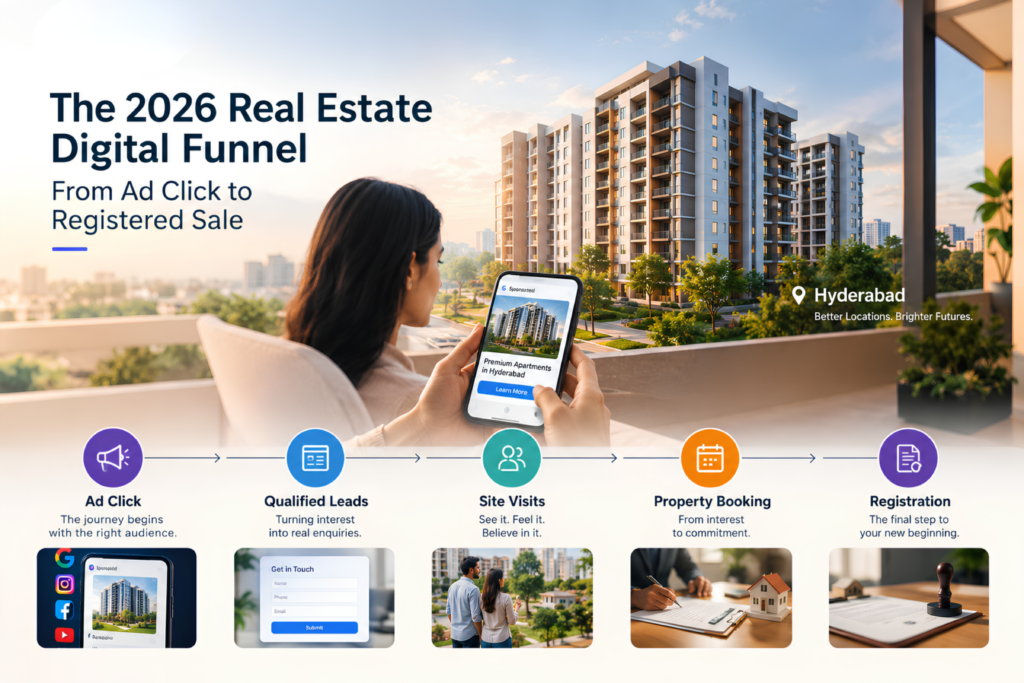
Instagram Ad → Project Landing Page → Enquiry → Qualified Lead → Site Visit → Booking → Property Registration
The business can then evaluate the performance of each stage instead of measuring success only through clicks or enquiries.
Useful practices include:
- Record lead sources consistently across campaigns.
- Assign unique campaign tracking parameters where appropriate.
- Connect the CRM with advertising and analytics platforms.
- Record site visits, bookings, cancellations, and registration status.
- Import suitable offline conversion events into advertising platforms where supported and permitted.
- Reconcile marketing reports with verified sales records.
Actual registrations should only be counted when the relevant milestone has been verified. A form submission or verbal commitment should never be reported as a registered sale.
Key metrics to track: Cost per booking, booking-to-registration rate, customer acquisition cost, marketing-attributed revenue, and return on advertising spend (ROAS).
This stage helps developers understand whether their marketing investment is generating commercially meaningful results.
How to Measure the Performance of Your Real Estate Digital Funnel
A digital funnel becomes more valuable when each stage has a measurable objective.
| Funnel stage | Important metric | What it reveals |
|---|---|---|
| Awareness | CTR and CPC | Whether advertisements attract relevant attention |
| Interest | Landing page conversion rate | Whether visitors become enquiries |
| Qualification | Cost per qualified lead | Whether marketing attracts suitable prospects |
| Nurturing | Contact and response rates | Whether buyers engage with follow-ups |
| Remarketing | Assisted conversions | Whether returning visitors progress |
| Site visits | Visit-to-booking rate | Whether visits lead to purchase decisions |
| Final sales | Cost per registration and verified revenue | Whether marketing contributes to completed transactions |
Businesses should also examine conversion rates between consecutive stages. A large number of enquiries with very few site visits may indicate a lead quality or follow-up problem. Strong site visits but weak bookings may point to pricing concerns, project suitability, sales execution, or unresolved buyer objections.
The numbers help identify where to investigate instead of assuming that every problem requires a larger advertising budget.
Example: How a Real Estate Funnel Can Be Analysed
Consider a hypothetical property campaign that generates 1,000 website visits.
The following example illustrates how conversion rates can be calculated. These are illustrative numbers, not industry benchmarks or guaranteed results.
| Stage | Example volume | Conversion from previous stage |
|---|---|---|
| Website visits | 1,000 | — |
| Enquiries | 100 | 10% |
| Qualified leads | 40 | 40% |
| Completed site visits | 20 | 50% |
| Bookings | 4 | 20% |
| Registered sales | 3 | 75% |
In this example, four bookings result from the campaign’s tracked buyer journey, and three transactions reach the verified registration milestone.
The figures also highlight possible opportunities for improvement. If more qualified leads can be encouraged to attend site visits, or if the business can address the reasons some bookings do not progress to registration, the overall funnel may perform better.
However, the business must also consider advertising expenditure, sales costs, cancellations, attribution rules, and the time required for transactions to complete.
The important lesson is that marketing performance should be evaluated across the entire buyer journey, not just by the number of leads generated.
Common Mistakes That Weaken a Real Estate Digital Funnel
Even businesses investing heavily in advertising can lose opportunities when their funnel is poorly managed.
1. Focusing Only on Low-Cost Leads
A low cost per lead may look attractive, but it does not reveal whether the enquiries are relevant or likely to progress.
Better approach: Compare the cost of qualified leads, completed site visits, and bookings across campaigns.
2. Sending All Traffic to One General Page
A generic landing experience may not answer the specific questions raised by an advertisement.
Better approach: Align the landing page with the promoted project, location, configuration, and offer.
3. Delaying Lead Follow-Ups
Interested buyers may contact multiple developers. Delayed responses can reduce the opportunity to start a useful conversation.
Better approach: Establish clear response-time expectations, assign lead ownership, and monitor unanswered enquiries.
4. Ignoring Leads That Are Not Ready to Buy
Not every buyer is prepared to make a decision immediately.
Better approach: Use relevant, consent-based nurturing to support longer decision cycles.
5. Failing to Connect Marketing and Sales Data
When advertising reports and CRM records are disconnected, businesses may struggle to determine which campaigns contribute to sales.
Better approach: Maintain consistent campaign tracking and record lead progression through booking and registration.
6. Making Unsupported Advertising Claims
Unverified appreciation projections, misleading urgency, or unclear project information can undermine buyer trust and create compliance risks.
Better approach: Use accurate claims, appropriate disclosures, and verified project details. Ensure that applicable real estate advertising and data protection requirements are followed.
How NXZ Can Help Real Estate Businesses Build a Stronger Digital Funnel
A successful property marketing strategy requires more than running advertisements. It needs a clear connection between audience targeting, campaign messaging, website experience, enquiry management, and sales outcomes.
NXZ helps real estate businesses approach digital marketing with a focus on attracting relevant audiences and improving the journey from initial interest to qualified enquiries.
Depending on a project’s requirements, a digital marketing strategy may include:
- Paid advertising: Campaigns designed to reach relevant property buyers through suitable digital channels.
- Landing page optimisation: Clear project information and enquiry journeys that make it easier for visitors to take action.
- SEO and content marketing: Useful content that helps buyers discover projects while researching locations, developers, and property options.
- Remarketing strategies: Relevant communication for eligible audiences who have previously engaged with project content.
- Conversion tracking: Measurement of campaign performance beyond clicks and basic lead volume.
- Performance analysis: Reporting that helps businesses identify funnel bottlenecks and make informed marketing decisions.
The right approach depends on the project, audience, budget, available sales data, and business objectives.
The aim is to create a more connected marketing process where each activity supports the next step in the buyer journey.
Conclusion: Turn Digital Interest into Measurable Real Estate Growth
In 2026, real estate businesses need to look beyond impressions, clicks, and enquiry counts. The real opportunity lies in understanding how potential buyers move through the entire purchase journey.
A well-structured Real Estate Digital Marketing Funnel connects advertising, landing pages, lead qualification, nurturing, remarketing, site visits, and sales tracking into one measurable system.
When these stages work together, developers can identify wasted expenditure, improve communication with prospective buyers, and make better-informed decisions about their marketing investments.
For businesses looking to strengthen their digital presence and build a more effective path from enquiries to sales, NXZ can help develop a strategy aligned with their marketing goals.
Ready to improve your real estate marketing strategy? Connect with NXZ to explore how a structured digital marketing approach can help your business attract relevant audiences and build a clearer path from ad clicks to property sales.
Frequently Asked Questions (FAQs)
1. What is a real estate digital marketing funnel?
A real estate digital marketing funnel is a structured process that guides potential property buyers from discovering a project online to enquiring, attending a site visit, booking a property, and potentially completing registration.
2. Why is a digital funnel important for real estate developers?
It helps developers understand how marketing enquiries progress through the sales process, identify where buyers drop off, improve lead follow-ups, and evaluate campaign performance against business outcomes.
3. Which advertising platforms are useful for real estate marketing?
Google Ads can help reach people actively searching for properties, while Facebook and Instagram can introduce projects to relevant audiences through visual campaigns. SEO, YouTube, and remarketing can support other stages of the buyer journey.
4. How can real estate businesses improve lead quality?
Businesses can improve lead quality through relevant audience targeting, accurate advertisements, project-specific landing pages, appropriate enquiry questions, and consistent lead qualification.
5. What is the difference between a property booking and a registered sale?
A booking indicates that a buyer has reached a particular stage of the purchase process. A registered sale refers to a transaction that has reached the applicable property registration milestone. The two should be tracked separately.
6. How does CRM help in real estate digital marketing?
A CRM helps organise enquiries, track conversations, assign follow-up tasks, record site visits, and monitor sales milestones. When integrated appropriately with marketing analytics, it can also help businesses evaluate campaign contributions to sales.
7. How can NXZ help with real estate digital marketing?
NXZ can help real estate businesses explore paid advertising, SEO, content marketing, landing page optimisation, remarketing, and performance tracking based on their specific requirements and objectives.